A fight for light

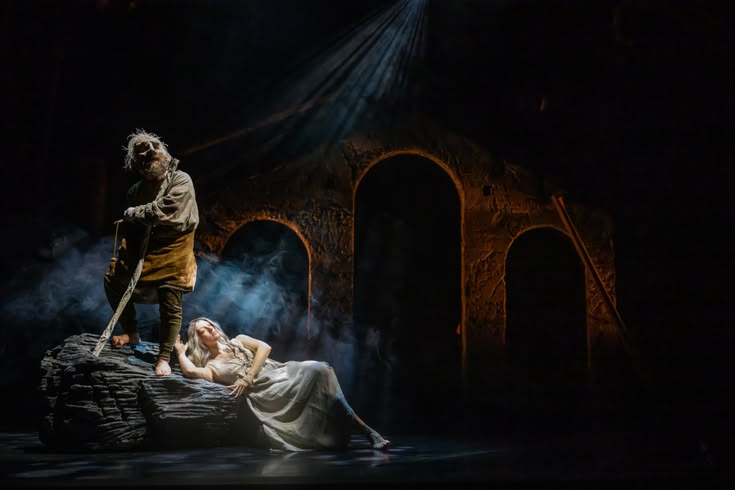
Nine minutes of battle. No prophecy. No heath. No sisters. The plot is kept on hold until the bloodshed is over – it would be comic, if it were not. Then the supernatural arrives, out of a puddle, as a humanoid shape looting itself into being. Nothing here is called a witch, and nothing is sent from outside: the creatures ooze from the characters themselves.

The recipients of the non-verbal prophecy vomit a black viscous something, and it is the same something the creatures are made of, – the same that will later seep from the walls and more. Evil is not agency here, yet substance – secreted by the body, wiped away in a hustle, hidden under the carpet, refusing to stay hidden, less as oil than as excrement.

The casting is the argument. Lionel Lingelser plays Lady M. Sophie Botte plays Banquo. Delphine Cottu plays Duncan, grotesquely padded, and also Fleance, and also Lady Makduff: one body carries the king, the child and the mother, – all the victims wearing the same face under a different mask. All damaged beyond repair – obesity, mental health, incest. 

Duncan arrives, the welcome dinner plays over Feel so good by Bobby Harden and the Soulful Saints, the plot advances on Kiss you all over by Exile, and the king appears to be choking, ‘gleefully’ yet against Shakespearean intent. The music is not ironic distance. The feast is a real good time, which is what makes the murder unbearable rather than inevitable.

Louis Arene does not stage his Makbeth to instruct us about despotism, or ambition. Munstrum’s is not a theatre of catastrophe and cruelty, yet of laughter and surprise. Theirs is “a quest for Joy”, – the somber kneaded through the luminous, hence it delivers a mise en scène which could be an abattoir as well as a fun for fun party. And it is an act of endurance.

The parts emphasised en travesti are the finest, and the soundtrack belongs to a rainbow club. The gaiety — in both senses, and here they are not separable — is not relief from the horror; it is the company’s stated method for subsisting on it. The drag does not undercut the tragedy, it informs and shapes the production in the search for joy.

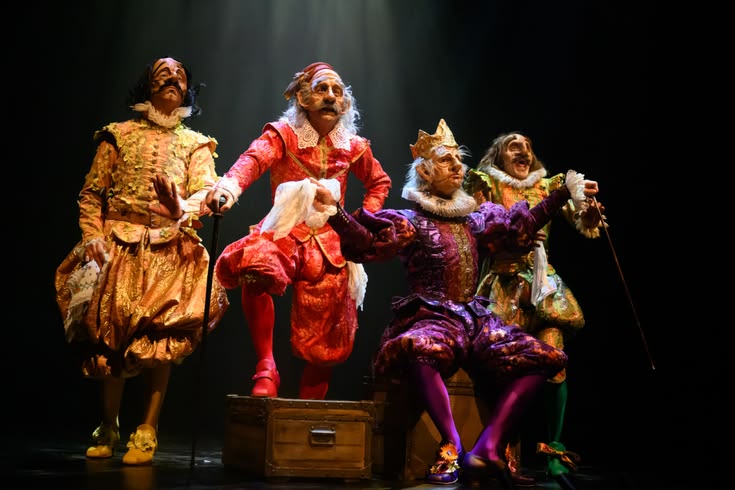
The Fool in the hands of a circus performer is intriguing, yet the intermezzo itself is harder to defend. It pauses to apologise, on the grounds that Shakespeare might turn in his grave – a concept which is explained in the language of the poet himself. Yet irreverence without corruption of the folio earns the right to be outright, without need of permission.

The passage through the Makbeths’ farewells is welcomed by Need you tonight (Kick) by INXS – introducing to the antechamber of full-wide madness and sleepwalking. The creatures that wrap around him and drag him down are the same black matter, returned for the body that produced it. She goes the same way, but her descent is a tad more drag than his.

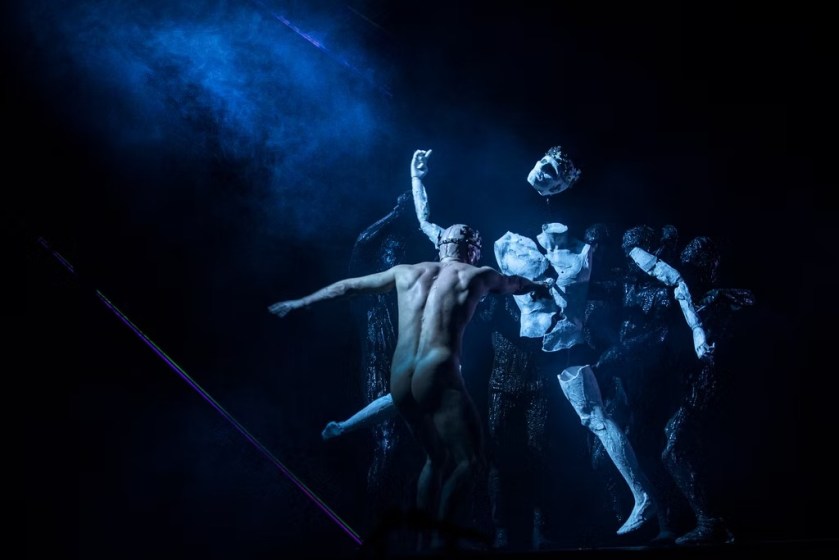
The king is now naked. In a sublime rebirth without words, the produce is shame. Wearing the crown as Gollum would wear the ring – the same posture, he is now exposed. Then the fallacious gift of a dismembered mirror – from the crowned head on, returning the black matter to the ground it came from, — a triumph that looks like a hangover.

The most flamboyant expression of a fight for light. 
Jean-Louis Fernandez

The voice of the wind

Then, all of a sudden, came the realisation that a pendulum governs “the hermeneutics of the tempest“, swinging the plot in the whereabouts of the comedy or the tragedy, determined by where the plot decides to swing away. Not any pendulum in this choice, yet the one Foucault intended, to manifest Earth has a motus of its own.

Colombian director Omar Porras` choice for his mise en scène “gravitates“ – this must be the verb to be used, around the status of the Earth. Some dose of nostalgia of a golden age edges into yearning in La Tempête ou la voix du vent, not as much as it would if the swinging were to be somber or dark, though. In his manifestation of the disquieting state of the planet, he is gentle.

The result is a full rounded artistic laboratoire to delve into the essence of the “tempest“ which is indeed not a climatic event, yet a state, an emotion of the earth; in the Amerindian culture of the kogis, in Colombia, the shikwa is the invisible cord wrapping up the earth, connecting it with the sun and the rest of the universe, and granting its constant rotation.

Maintaining this balance is no longer the issue at stake, it is more of an earthquake of a sort, un craquement – that is now threatening the balance. Indeed, a tempest. As such, the plot gives a voice to the earth, to express this sentiment, and to give a chance of redemption to mankind for what has been done to the planet and the environment.

`Caliban! Thou earth, thou! Speak.`
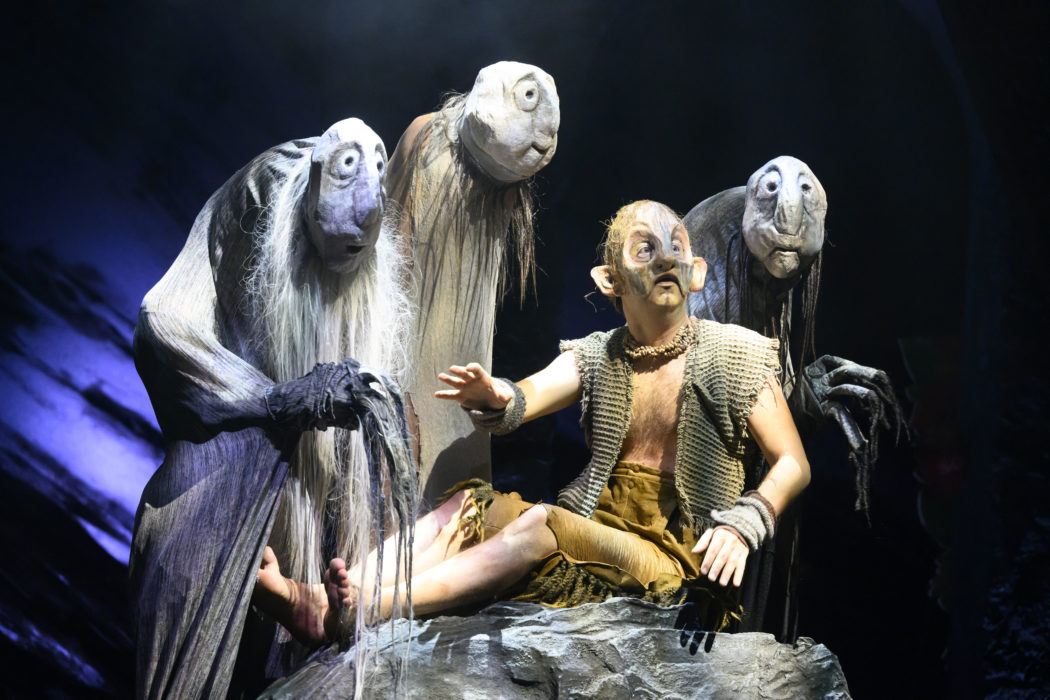
This line cracks this interpretation to the core, yet not in a manifest way. The ecological meaning of the line is imaginative and kind, following the plot in the land of comedy aided by fragments of diverse creative devices of the visual theatre: masks, puppets, lights, music.

In the directors` intentions, the shipwrecked are confronted with a “new world“, yet the major themes of forgiveness, justice, freedom manifest in segments interlacing respectively with the beauty of “humanity“, the uselessness of power, and the clumsiness of violence.

Way before the hermeneutics, are the actors, though, entering the stage from the hall, a happy crew, at the TKM Qui veut dire quoi? Théâtre KléberMèleau.
A placid elderly storyteller more than a tyrannical wizard, Prospero lulls Miranda asleep with star-dust while summoning a Puck-like Ariel whose weapon is a musical chuckle, more than thunder.

Exotic flowers and a surreal vegetation suggest the island is more of a forest – a green space where some would venture to face change, or redemption; and “the-sleep-per-chance-to-dream“ backdrop is indeed ventured aloud by the entering parade, swinging the pendulum in the adjacency of A Midsummer Night`s Dream.

Ferdinand is a sweet goofball who cannot see the surrounding puppet creatures, while Caliban does and he would not mind reign over them, now that he knows the language of domination, but is powerlessly taken for a fish and spoken to in Portuguese by Stefano and Trinculo. Mirrored elsewhere, the Neapolitan court plots without shame chased by an invisible swarm of buzzing insects.

Change indeed happens, in Gonzalo`s voice, wishing a republic with no magistrates, no contracts, no masters, no matrimonies and a whole producing Nature: `We have been wandering in a maze!`. All is forgiven, free, human.